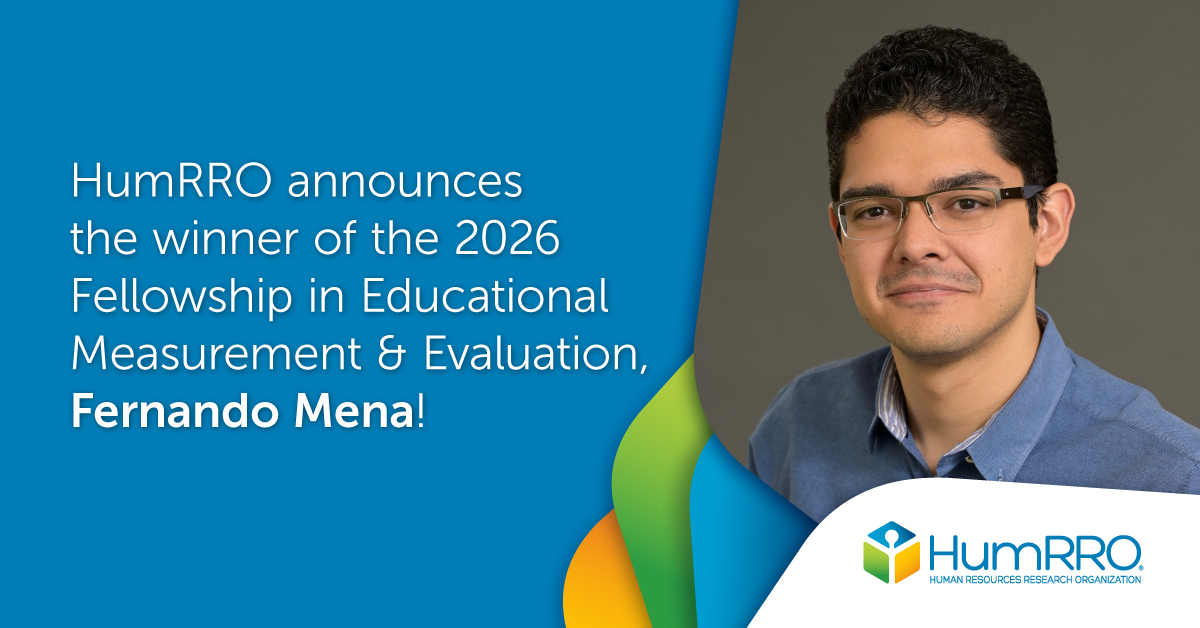
HumRRO is pleased to announce that Fernando José Mena Serrano, a doctoral candidate in Research, Educational Measurement, and Psychometrics at the University of Massachusetts Amherst, is the recipient of the 2026 HumRRO Fellowship in Educational Measurement and Evaluation. Mena’s dissertation research examines how artificial intelligence (AI) can support assessment development by evaluating the dimensional structure of test items before data are collected from examinees.
The HumRRO Fellowship in Educational Measurement and Evaluation recognizes doctoral students whose research demonstrates exceptional promise for advancing educational measurement theory and practice. HumRRO has also awarded an annual HumRRO Fellowship in Industrial-Organizational Psychology since 1998. (Read about the 2026 HumRRO I-O Fellowship winner, Vivien Lee.)
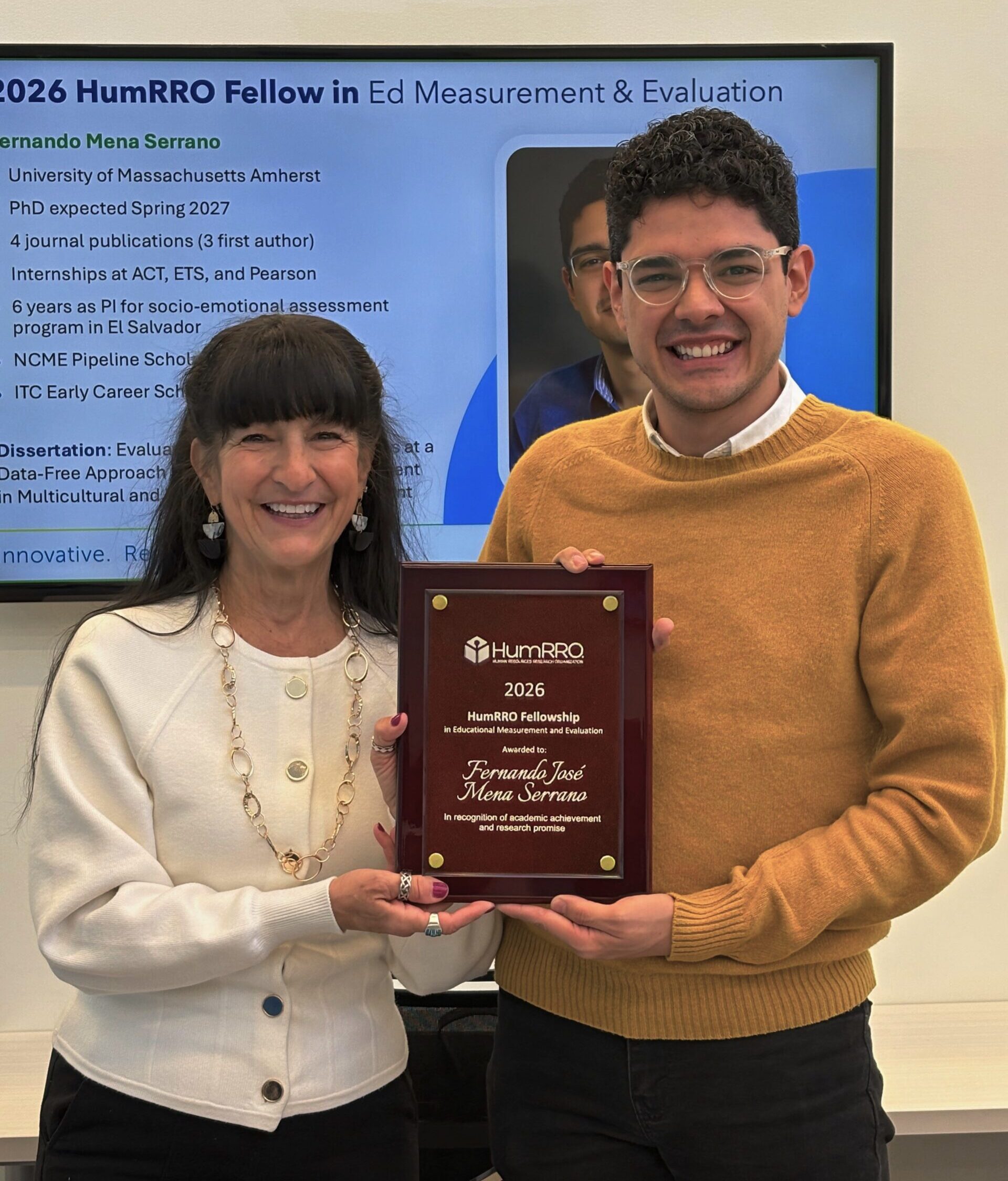
HumRRO CEO Dr. Suzanne Tsacoumis presented Fernando Mena with the HumRRO Fellowship in Educational Measurement and Evaluation.
Mena’s dissertation focuses on an emerging methodology known as pseudo-factor analysis, which uses language model embeddings to represent the meaning of assessment items and evaluate whether they align with an intended conceptual structure. His research compares AI-generated results with traditional factor analyses based on student response data and examines how well the method performs across languages, assessment settings, and different AI models.
“Receiving the HumRRO Educational Measurement and Evaluation Fellowship is both an honor and an important affirmation of the work I am pursuing,” said Mena. “HumRRO has a long history of applying rigorous measurement research to practical problems, so receiving support from an organization with that mission is especially meaningful to me.”
Mena said he was inspired to pursue the research because of interest in making high-quality assessment development more accessible, particularly in contexts where resources are limited.
His experience leading social and emotional assessment initiatives in El Salvador helped shape that interest. By investigating whether AI can be used responsibly and rigorously during the early stages of test development, he hopes to contribute evidence that supports efficient assessment practices while maintaining psychometric quality.
“Coming from El Salvador, where resources for test development are often limited, I see this work as an opportunity to expand access to rigorous assessment practices,” Mena added. “My goal is to help ensure that innovations in AI are evaluated carefully and can be used fairly across different languages, cultures, and educational settings.”
“Fernando’s research explores one of the most important questions facing the assessment community today: how emerging AI technologies can be incorporated into measurement practice responsibly and effectively,” said Suzanne Tsacoumis, Ph.D., HumRRO President and CEO. “I am particularly impressed by his commitment to applying advanced psychometric methods in global contexts, and we look forward to seeing his continued contributions to the field.”
The fellowship provides a non-renewable stipend of $18,000 that Mena plans to use to support the completion and dissemination of his dissertation research. The funding will help cover research-related expenses and enable him to devote additional time to the extensive analyses required for the study and the presentation of findings to the educational measurement community.
Mena expressed gratitude to his dissertation chair, Javier Suárez-Álvarez, Ph.D., for helping develop and refine the research, as well as to committee members Scott Monroe, Ph.D., his advisor throughout his doctoral studies, and Sue Lottridge, Ph.D., for their guidance and expertise. He also thanked Stephen Sireci, Ph.D., Lisa Keller, Ed.D., Craig Wells, Ph.D., and April Zenisky, Ed.D., for their mentorship and support throughout his doctoral journey.
Applications for the 2027 HumRRO Fellowship in Educational Measurement and Evaluation and HumRRO Fellowship in Industrial-Organizational Psychology will open in April 2027.

For more information, contact: